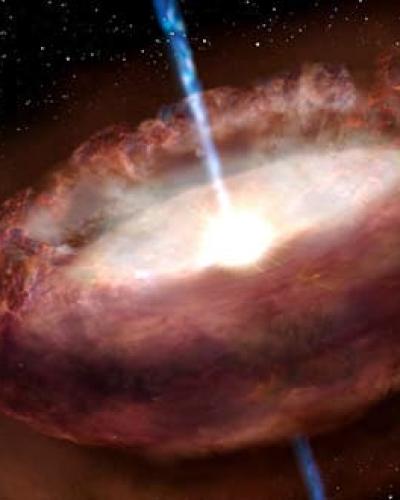
We explore the most energetic and unusual objects in the universe — black holes, neutron stars, exploding stars, and the powerful cosmic events that occur when these objects collide or collapse. Our work studies how matter and energy behave under conditions that cannot be recreated on Earth, where gravity, density, magnetic fields, and temperature reach extraordinary extremes. Using observations across the electromagnetic spectrum, along with gravitational waves and other “multi-messenger” signals, scientists investigate phenomena such as fast radio bursts, supernovae, compact object mergers, and the environments surrounding black holes and neutron stars. These events not only test the fundamental laws of physics but also help explain how elements are created and how galaxies and cosmic structures evolve over time.
Researchers combine theoretical physics, large-scale simulations, data science, and advanced instrumentation to better understand the extreme universe. Cornell scientists contribute to the development of next-generation observatories and detector technologies that facilitate discoveries in radio astronomy, cosmology, gravitational-wave science, and high-energy astrophysics. By studying the universe under its most extreme conditions, Cornell researchers are helping answer fundamental questions about the nature of space, time, matter, and the dynamic processes that shape the cosmos.
Related people

Associate Professor

Research Associate, CCAPS

Associate Professor

Professor

George Feldstein Professor of Astronomy

Assistant Professor

Edward L. Nichols Professor of Physics and Professor of Astronomy

Professor Emeritus

Richards Family Assistant Professor

Klarman Fellow CCAPS

Senior Research Associate, CCAPS

Senior Research Associate, CCAPS

Postdoctoral Associate CCAPS

Hubble Postdoctoral Fellow -CCAPS

Professor Emeritus

Professor and Director, Laboratory of Elementary Particle Physics

Visiting Scientist, CCAPS

Jansky Postdoctoral Fellow at Cornell University and the National Radio Astronomy Observatory - CCAPS

Kenneth A. Wallace Professor Emeritus of Astronomy , Professor Emeritus of Physics