
Astronomer paints vivid history of Arecibo Observatory
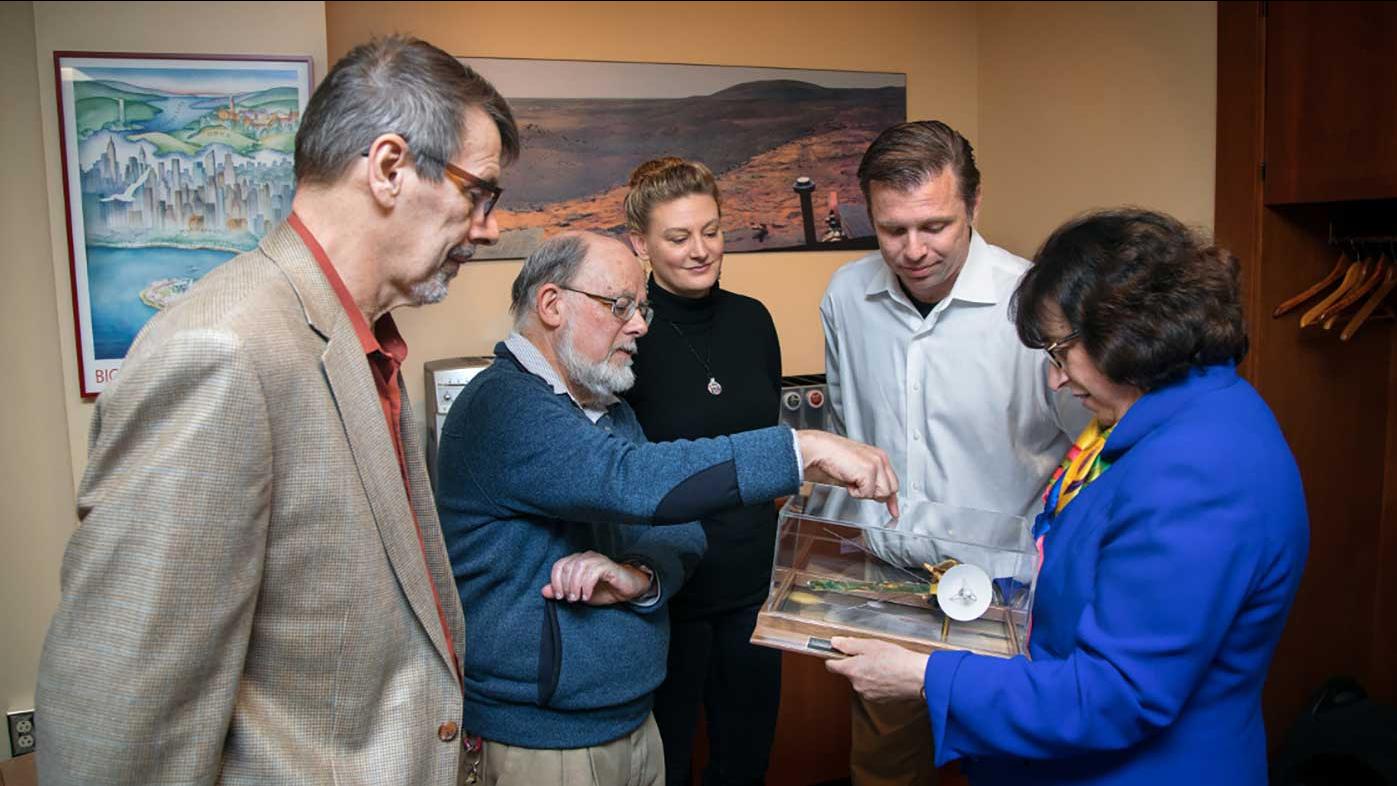
In a new book, Donald Campbell, Ph.D. ’71, professor emeritus of astronomy, recounts the history of Arecibo from construction to its last days under Cornell’s management in 2011.
Read more
Department Homepage
The department places strong emphasis on the participation of students in ongoing research projects and strives to foster an interdisciplinary approach to solving astronomical problems by maintaining strong ties with other departments. Many undergraduate and graduate alumni of Cornell astronomy have become leaders in the field.
There are numerous ways to support our department. Click here to learn more about Friends of Astronomy, a group of Cornell Astronomy alumni and friends who work to encourage significant interaction between the department and our friends in the wider world.
If you're interesting in giving a gift to support our students, research or outreach efforts, please explore the donation links below:
In a new book, Donald Campbell, Ph.D. ’71, professor emeritus of astronomy, recounts the history of Arecibo from construction to its last days under Cornell’s management in 2011.
Read more
The Global Radio Explorer telescope is a series of eight terminals being built and tested at Cornell and the California Institute of Technology, and installed at locations around the world.
Read more
To equip astronauts with health choices for future missions, a Cornell postdoctoral fellow is leading research with AstroCup, a group that recently tested two menstrual cups in spaceflight as payload on an uncrewed rocket flight.
Read more
"Nexus Scholars was the first time where the only thing I had to worry about was research."
Read more
The portraits are part of a series by Christopher Michel, the National Academies of Sciences, Engineering and Medicine’s inaugural artist-in-residence.
Read more
Cornell researchers have created the first reflectance spectra – a color-coded key – of microorganisms that live in the clouds floating above Earth’s surface.
Read more
Astronomers have generated the first three-dimensional map of a planet orbiting another star, revealing an atmosphere with distinct temperature zones – one so scorching that it breaks down water vapor, a team co-led by a Cornell expert reports in new research.
Read more
These simulations, developed with significant input from Cornell researchers using code written at Cornell, help scientists analyze gravitational waves observed by the LIGO, Virgo and KAGRA detectors located in the U.S., Italy and Japan.
Read more