
Introduction
For as long as there have been people on Earth, we have looked up at the sky and wondered about the Sun, Moon, stars, and occasional dramatic events we saw there. But it is only in the past 50+ years that we developed the technical ability to leave our planet and actually visit other bodies in the universe.
Since the early days of space exploration, Cornell astronomers have played major roles in NASA missions to explore the solar system and distant universe. This strong tradition, going back to Thomas Gold and the Apollo mission to the Moon, and Carl Sagan and the early exploration of Mars by Mariner 9 and Viking, continues today. The Infrared Spectrometer (IRS), a major instrument on the Infrared Telescope Facility (Spitzer Infrared Telescope Facility), was developed by a group at Cornell. The focal point for the analysis of data being collected by this instrument was the IRS Data Center located at Cornell. Cornell planetary scientists played big roles in the NEAR mission which culminated in the successful landing on asteroid 433 Eros in 2001, and were responsible for developing the Athena instrument package for the Mars Exploration Rovers: Spirit and Opportunity. Under Cornell leadership the rovers collected a wealth of observational data on the ancient climate of the planet.
Space Missions
James Webb Space Telescope (JWST)
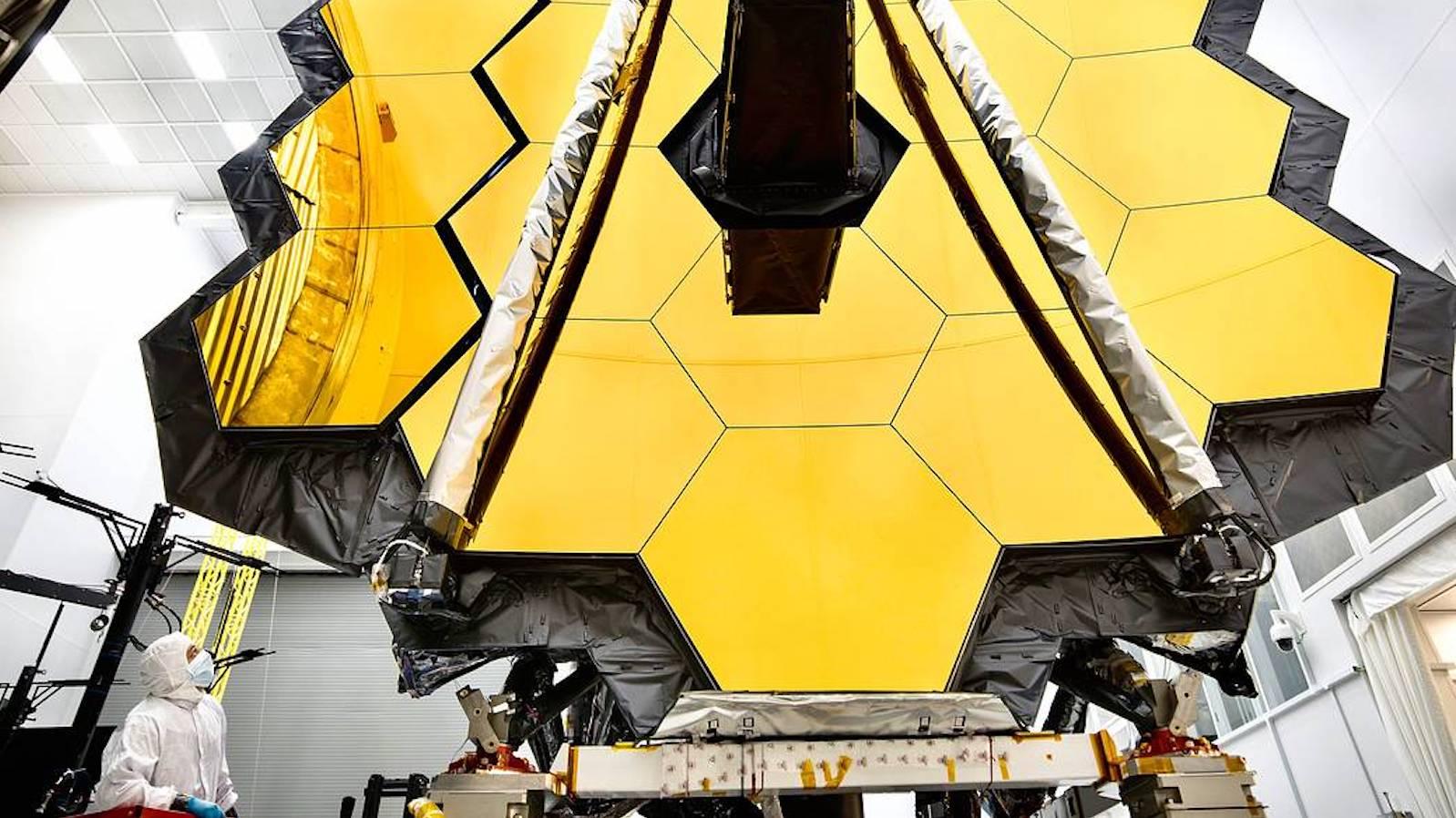
The James Webb Space Telescope (JWST), launched December 25, 2021, is the most powerful space observatory ever built. Orbiting the Sun 1.5 million kilometers from Earth, it studies every phase in the history of our Universe — from the first luminous glows after the Big Bang to the formation of solar systems capable of supporting life. With unprecedented infrared sensitivity, Webb can peer back more than 13.5 billion years to observe the first galaxies ever formed.
Cornell CCAPS researchers are deeply embedded in JWST science. Associate Professor Nikole Lewis serves as principal investigator on a scientific team investigating exoplanet atmospheres in the TRAPPIST-1 star system, leading over 130 hours of guaranteed time observations. That involvement has only grown: in Cycle 4, Prof. Lewis's Substellar Explorers group secured more than 350 hours of awarded observing time across multiple programs, with Cornell graduate students and postdoctoral researchers earning time as principal and co-principal investigators. This has been a significant achievement in one of JWST's most competitive cycles to date.
Affiliated Researchers:
Pandora SmallSat

The Pandora SmallSat launched in January 2026 as the first satellite in NASA's Astrophysics Pioneers program. The Pioneers are a new class of small-scale, low-cost missions designed to deliver compelling science while training early-career researchers in mission leadership. Equipped with a 0.45-meter telescope, visible-light photometry, and near-infrared spectroscopy, Pandora will study the atmospheres of at least 20 exoplanet systems around small stars over its one-year mission, helping scientists disentangle true atmospheric signals from the interference caused by stellar activity.
Prof. Nikole Lewis is a member of Pandora's science team. Cornell alumnus Trevor Foote, Ph.D. '24, a former member of Lewis's research group, serves as a mission manager coordinating operations across three centers. Pandora works in close coordination with JWST, providing complementary long-duration observations that sharpen the interpretation of JWST atmospheric data.
Affiliated Researchers:
- Nikole Lewis
- Trevor Foote
Dragonfly
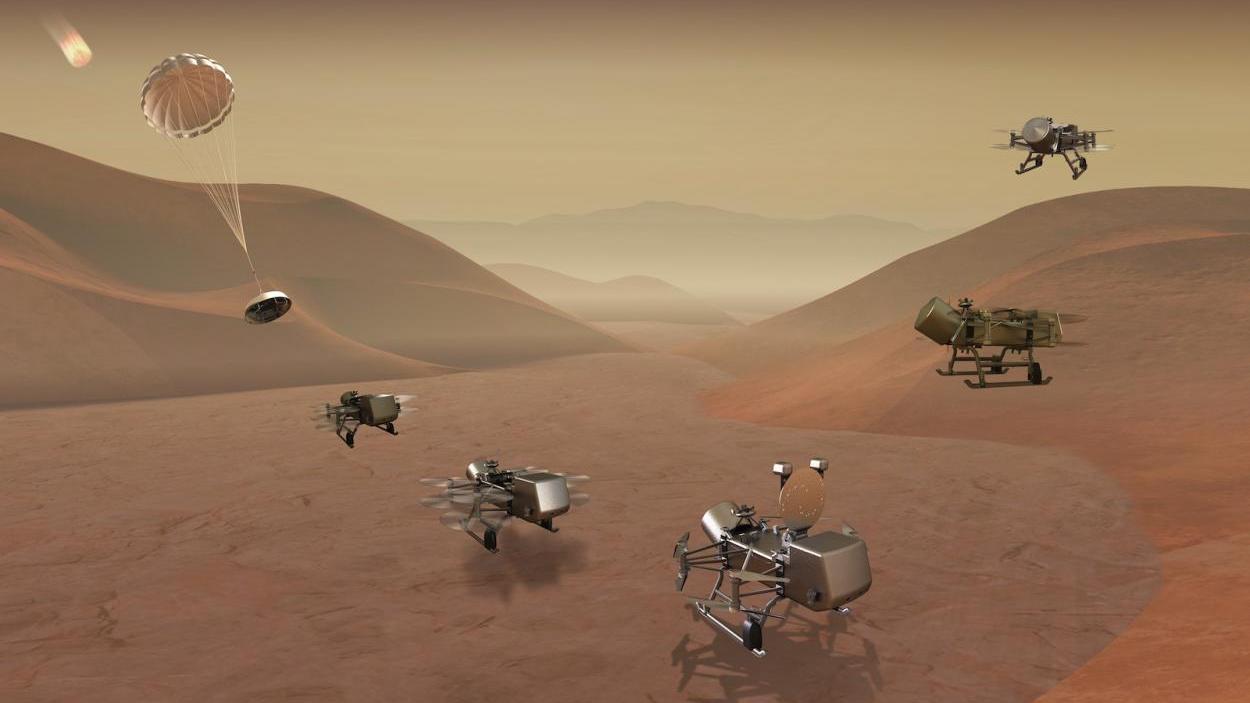
Dragonfly is a rotorcraft lander mission that will fly to multiple locations on Saturn's moon Titan to investigate its habitability and the progression of prebiotic chemistry. It is part of NASA's New Frontiers Program. Titan's dense atmosphere and low gravity make flight an ideal mode of travel, allowing Dragonfly to cover hundreds of kilometers during its planned 3.3-year mission, sampling surface material and measuring atmospheric conditions at geologically diverse sites. The mission is scheduled for launch no earlier than July 2028, with arrival at Titan expected in late 2034.
Affiliated Researchers:
Europa Clipper

Jupiter's moon Europa is considered one of the most promising potentially habitable environments in our solar system, harboring a vast ocean of liquid water beneath its icy crust. NASA's Europa Clipper launched in October 2024 and will conduct nearly 50 close flybys of Europa beginning in 2030, investigating the moon's interior structure, composition, and geology. This is NASA’s first dedicated spacecraft mission to study an ocean world beyond Earth.
CCAPS researchers hold key roles across several of the mission's science teams. Prof. Alex Hayes is a co-investigator for the Europa Imaging System (EIS), which will deliver the highest-resolution images of Europa's surface ever captured. Prof. Britney Schmidt is a co-investigator on the REASON ice-penetrating radar instrument, which will probe inside Europa's ice shell for the first time. Her lab has also developed Icefin, a robotic underwater vehicle built at Cornell and deployed beneath Antarctic ice shelves to explore the most Europa-like environments accessible on Earth. The work studies the limits of life and the evolution of ice-ocean interactions, with the explicit goal of developing the technology and scientific framework needed for a future robotic probe to explore Europa's ocean. Principal Research Scientist Michael Mellon is also a co-investigator on the E-THEMIS thermal imaging instrument, which will map surface heat retention and search for evidence of active venting or subsurface lakes.
Affiliated Researchers:
Mars 2020/Perseverance

NASA's Mars 2020 Perseverance rover landed at Jezero Crater in February 2021 with the mission to search for signs of ancient microbial life and collect rock and regolith samples for potential return to Earth. Jezero Crater was once flooded with water and contains the remains of an ancient river delta — a prime target for preserving evidence of past habitability. In 2025, the journal Nature published peer-reviewed results confirming that Perseverance's "Sapphire Canyon" sample from a rock named "Cheyava Falls" contains potential biosignatures — the closest science has come to discovering evidence of past life on Mars.
Cornell CCAPS researchers Prof. Alex Hayes and Senior Visiting Scientist Don Banfield serve as Co-Investigators on the MastcamZ investigation, the rover's primary imaging system. Principal Research Scientist Michael Mellon also contributes to the mission.
Cornell has an unbroken thread of rover camera leadership across four Mars missions spanning more than two decades. Prof. Jim Bell (adjunct) served as Principal Investigator for the panoramic camera on both the Spirit and Opportunity rovers, NASA's groundbreaking Mars Exploration Rovers that reshaped our understanding of ancient Martian habitability during their combined decades of operation. Bell now serves as Principal Investigator for Mastcam-Z on Perseverance, providing direct continuity of Cornell-led Mars imaging leadership across four rover missions. He also serves as Deputy Principal Investigator on the NASA Psyche mission, which completed a successful Mars gravity assist in May 2026 and is now on course for arrival at the metal-rich asteroid Psyche in summer 2029 — the first mission to explore an asteroid believed to be the exposed metallic core of an early planet, offering a unique window into the building blocks of rocky worlds like Earth.
Affiliated Researchers:
Habitable Worlds Observatory

The Habitable Worlds Observatory (HWO) is NASA's next flagship astrophysics mission, currently in technology development and concept maturation. Its primary goal is to directly image at least 25 potentially habitable worlds and search their atmospheres for chemical biosignatures. This will be the first telescope designed specifically to answer whether Earth-like planets around Sun-like stars are common, and whether any show signs of life.
Prof. Dmitry Savransky (Sibley School of Mechanical and Aerospace Engineering) plays key roles in both NASA's Roman Coronagraph and Habitable Worlds Observatory efforts, developing advanced tools for wavefront control, autonomous telescope alignment, and mission scheduling, and working to translate ambitious science goals into feasible observing systems. His lab's graduate students are actively engaged in HWO mission simulations, combining mission design concepts with atmospheric models of Earth-like exoplanets to simulate observations and determine surface and atmospheric composition through retrieval techniques. The Roman Space Telescope's coronagraph, slated for launch by May 2027, will serve as a critical technology testbed directly informing HWO's design.
Affiliated Researchers:
Ground-based Missions
POEMM
POEMM (Planetary Origins and Evolution Multispectral Monochromator) is an approved NASA Astrophysics Pioneers mission focused on protoplanetary disk science, led by Cornell. The mission uses a 1.8-meter balloon-based telescope and far-infrared spectrometer optimized to probe the evolution of protoplanetary disks into planetary systems, measuring molecular hydrogen, water vapor, and oxygen at sub-AU scales to trace the formation of planets. POEMM is planned for launch on a zero-pressure helium balloon in the 2029–2030 austral summer, targeting a 20-day mission duration from Antarctica.
Prof. Gordon Stacey (Department of Physics) serves as Principal Investigator, with the POEMM team drawing on collaborators across Cornell and partner institutions.
Affiliated Researchers:
EXCITE

Another balloon-launch NASA mission, EXCITE (Exoplanet Climate Infrared TElescope) will study the atmospheres of hot Jupiter-like exoplanets. Infrared data will show how heat is distributed via winds across these planets, which are tidally locked to their host stars resulting in permanent day and night sides. Spectroscopic observations will also determine the types and distribution of molecules, such as water, in their atmospheres. The Lewis group has primary responsibility for analysis and interpretation of EXCITE mission science data, which will be collected in January 2027.
Affiliated Researchers:
Simons Observatory / CCAT / CMB-S4
The Simons Observatory is a multi-telescope array in Chile's Atacama Desert, now in active scientific operations, designed to probe the physics of the universe's earliest moments by measuring the cosmic microwave background — the faint afterglow of light from roughly 380,000 years after the Big Bang. Its instruments search for fluctuations in CMB polarization caused by gravitational waves generated in the instant after the Big Bang, offering a potential window into cosmic inflation — the theorized period of exponential expansion in the universe's first fraction of a second.
Prof. Michael Niemack leads the Cornell team in the Simons Observatory collaboration, and his group played a significant role in building and operating the predecessor six-meter Atacama Cosmology Telescope (ACT) from 2008 to 2022, which produced landmark detections of CMB gravitational lensing and some of the tightest constraints on the Hubble constant to date. His lab is now developing instruments for both the Simons Observatory and the CCAT Observatory, while contributing to the longer-term CMB-S4 program — a next-generation ground-based telescope network designed to measure the microwave background with an order of magnitude greater sensitivity than current instruments.
Affiliated Researchers: